You can't talk to your friends about this. They think you're doing great.
You make good money. Maybe very good money. And you're quietly drowning in it. Not because you're bad with numbers. Because there's no one safe to say that to.
The silence around money isn't protecting you. It's the thing that's making it worse.
They see the job title, the car, the house. They assume you're comfortable. Some of them probably envy you a little. And that's exactly why you can't say anything. How do you tell the person across the table that you've been doing the 2 AM math again, lying awake calculating whether you can cover the mortgage and the credit card minimum and the tuition payment all at once? You'd sound ungrateful. Or irresponsible. So you nod at the dinner party, smile, and change the subject when anyone brings up savings.
You've thought about talking to someone. A professional. But the idea of sitting across from a stranger and admitting that you earn this much and have this little to show for it? That conversation feels worse than the problem itself. You're smart enough to earn this much. You should be smart enough to manage it. That's what it feels like they'd think, even if they'd never say it. So you don't make the appointment.
Maybe you've tried. Maybe the conversation started calm and ended in blame. Or maybe you've never brought it up at all, because the moment you say "we need to talk about money," everything gets tense. So you absorb it. You carry the weight by yourself because the alternative, a fight that solves nothing, feels worse than the silence.
Here's the part nobody names. It's not just the financial stress. It's the shame about the stress itself. Because you know, logically, that a lot of people would love to have your income. You know you "should" feel grateful. And so the shame doubles. You feel bad about your money situation, and then you feel bad about feeling bad, because you have no right to complain.
Secrecy feeds it. Silence makes it grow. And the judgment, real or imagined, locks it in place. You can't reach out because reaching out means admitting that the person everyone thinks is doing fine is actually not doing fine at all.
So you keep it to yourself. You open the banking app and close it again without looking. You avoid conversations about retirement. You tell yourself you'll figure it out next month, next quarter, next year. And the spiral tightens, not because you're irresponsible, but because the shame is doing exactly what shame always does when it's left alone in the dark.
Before you carry this one more day, look at the numbers. Not to scare you. To show you that this isn't your personal failure. It's practically the norm.
Source: 2025 Goldman Sachs Asset Management Retirement Survey
Kevin said what a lot of people feel and none of them say. That the weight wasn't just financial. It was the shame of knowing he should have figured this out by now. The silence he kept because admitting the problem felt worse than living with it.
What changed wasn't his income. It was finding something that helped him look at his money without making him feel worse about himself. That's a low bar. Almost nothing clears it.
He's a New York Times bestselling author and the founder of Becoming Minimalist, read by over 2 million people. He's written five books. Published 31 issues of a quarterly magazine about money. And he's never once told a reader they should feel ashamed of where they are.
Joshua isn't a financial advisor. He doesn't sell courses or pitch investment products. He writes about money the way a good friend talks about it: honestly, without pretending he has all the answers, and without a trace of condescension.
He and his wife Kim co-founded The Hope Effect, a nonprofit caring for orphaned children around the world. Kim was orphaned at birth. The work is personal, not performative.

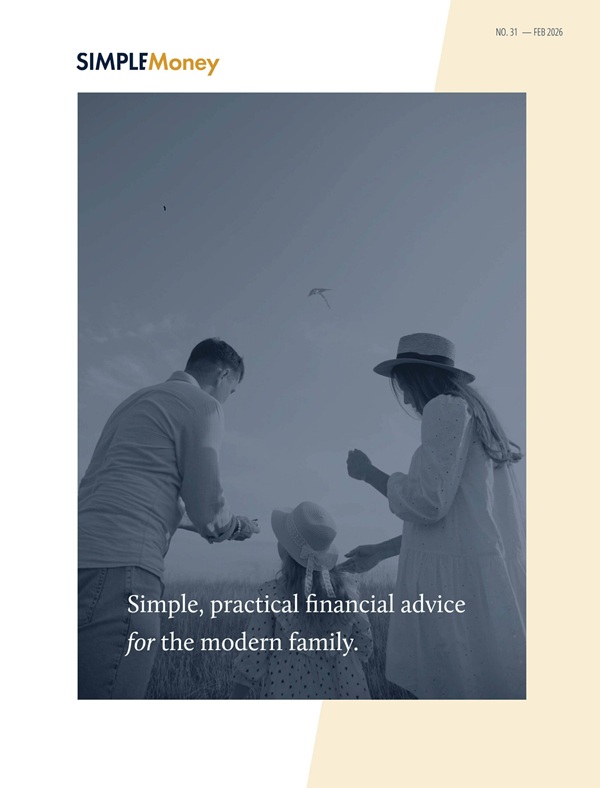
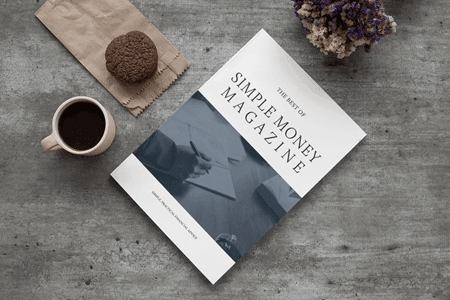
Simple Money Magazine is a digital publication. A PDF. It arrives in your inbox four times a year, and nobody has to know you're reading it. No app notifications. No social feed. No "share your progress" pressure. Just well-written articles about money, designed for adults who want honest guidance without the side of shame.
It also comes with a 10-Day Money Reset Email Series, which is the gentlest possible on-ramp. One small step a day. Private. No one sees your numbers but you.
Notice what happened in both stories. The magazine became the neutral third voice. Not a spouse blaming a spouse. Not an advisor lecturing from across a desk. Just an article, sitting on the kitchen counter, saying the thing neither person could say to the other. Sometimes the first step toward talking about money isn't talking at all. It's reading something together that makes the conversation safe enough to start.
Four issues a year, timed so you never drift too long without a reset. Think of it less as a subscription and more as a quiet reminder that you're paying attention to yourself.
Less than a single dinner out.
No subscription. No recurring charges. Pay once and you're in, forever.
If it doesn't help, you pay nothing.
Read the magazine. Try the worksheets. Go through the 10-Day Reset. If at any point in the first 60 days you feel like this isn't for you, send one email and you'll get a full refund. No forms, no questions, no awkwardness. This is supposed to make you feel better, not worse.
Honest answers, no sales pitch.
"I don't need a magazine, I need an accountant."
You might. And if you do, an accountant will help with the technical side. But here's what an accountant won't do: change the way you think about money. They'll optimize your taxes. They won't help you stop avoiding your bank balance. This magazine works on the part of your finances that spreadsheets can't reach, the habits, the mindset, the patterns. For a lot of readers, it's the thing that finally made them comfortable enough to call the accountant.
"I make too much money to need help with finances."
If that were true, you probably wouldn't be reading this page. And that's not a criticism. 48% of people earning over $100K are paycheck to paycheck. Earning a lot and managing it well are two completely different skills, and almost nobody teaches the second one. This is for high earners who want that second skill, without being made to feel stupid for not already having it.
"What format is the magazine?"
Digital PDF. It arrives in your email inbox, and you can read it on any device, anytime. No app to download, no account to create, no social features. It's private by design. The $50 tier also includes a hardcover book (20 best essays in print), shipped free anywhere in the world.
"What does 'lifetime access' actually mean?"
It means exactly what it says. You pay once. You get every issue that's ever been published (all 31 of them), plus every future issue for as long as the magazine exists. No renewal. No expiration. When Issue 32 comes out, it shows up in your inbox automatically.
"Is this a subscription?"
No. One payment. That's it. Nothing recurring, nothing to cancel, nothing to forget about. You'll never see a surprise charge. The irony of a money magazine that hits you with hidden fees would not be lost on us.
"$50 seems cheap. What's the catch?"
There isn't one. Joshua keeps the price low because the goal isn't to maximize revenue per customer. It's to get this into as many hands as possible. You're getting 31+ issues, a hardcover book, three bonus tools, and lifetime access to everything that comes next. The value is real. The price is intentional.
"Who writes the articles?"
Joshua Becker writes and edits the magazine. He's a New York Times bestselling author, the founder of Becoming Minimalist (read by 2M+ people), and the author of five books. He writes the way he talks: clearly, warmly, and without any interest in making you feel bad about yourself.
The first step isn't fixing your finances. It's finding a voice that doesn't make you feel worse about them.
This magazine won't lecture you. It won't judge where you are. It will meet you there and help you move, quietly, at your own pace, toward the place you actually want to be.
Get Lifetime AccessYou don't have to read it all at once. Most people start with one issue and the 10-Day Reset. Small steps. No pressure. The archive will be there whenever you're ready for it.
A portion of every sale supports The Hope Effect, Joshua and Kim Becker's nonprofit providing family-style care for orphaned children around the world. Kim was orphaned at birth. This isn't a marketing story. It's the reason the work exists.
If you've read this far, you already know this page is describing something you've felt. The silence, the shame, the isolation. You don't have to keep carrying that alone. Lifetime access starts at $35.